Everything you need for your crisis exercises
From the kickoff interview to post-exercise analysis, CrisisLab covers the entire cycle.
Why simulate?
A crisis picks its moment. Preparation is yours to pick.
72%
of organizations still have their first crisis exercise ahead of them
3x
faster response time after a CrisisLab exercise
89%
of trained teams respond better under pressure
CrisisLab (Tabletop Exercise) immerses your teams in a realistic crisis scenario, in complete safety. Facilitators, observers and participants play together to test your procedures, reveal what needs strengthening and cement your reflexes.
Crisis Lab gives you all the tools to design, run and evaluate these exercises: simulated communication channels, inject timeline, real-time scoring, and much more.
How does CrisisLab work?
- 01
Scenario design
Define the crisis context, escalation phases and pressure axes.
- 02
Event injection
Trigger injects in real time: emails, TV feeds, social media, SMS, phone calls.
- 03
Crisis team response
Participants make decisions, manage communications and log their actions.
- 04
Evaluation & debriefing
Observers and facilitators score performance. Generate the after-action report.
A guided end-to-end process
Every step is structured to produce a rigorous exercise worth showing.
- 01
Kickoff interview
Seven topics, one conversation: the assistant asks the questions and draws up a portrait of your organisation, its governance and its knowledge base. An interview replaces the form.
- 02
Scenario design
AI generates a complete scenario matched to your context — ransomware, APT, IT outage, reputational crisis — and maps it onto the MITRE ATT&CK matrix.
- 03
Actors & roles
Assemble your crisis unit, assign the seven application roles and prepare individual welcome kits.
- 04
Inject timeline
Build the schedule: escalation phases, multi-channel injects and decision points. Each inject is written from a brief — context first, then content.
- 05
Real-time execution
Run the exercise from the facilitator dashboard, the simulators and real-time WebSocket tracking.
Simulators that drop your teams into the real thing
Each channel faithfully reproduces the tools a crisis unit uses day to day.
Brought together into a real-time exercise room, these channels form the Simulation module, in preparation, launch planned for late 2026. Scenario design, deliverables and AI analysis are already available.
Simulated mailbox
Realistic email exchanges with named threads, attachments and scheduled delivery.
Social feed
A simulated social feed: posts, mentions, reactions and the climb into virality during the crisis.
TV & media feed
Simulated news broadcasts with breaking news, alert banners and studio control.
Crisis directory
Internal and external contacts, with role, reporting line and availability.
Call simulator
ComingVoice calls through multi-persona speech synthesis or pre-recorded audio files.
AI at the heart of every exercise
CrisisLab routes each task to the model that suits it, and leaves the choice of provider to you — up to a configuration operated entirely in France.
- Scenarios generated for your context and your regulatory regime
- Fully sovereign option: models operated in France, audio and video generation switched off
- Scenarios mapped to MITRE ATT&CK, with an exportable Navigator layer
- Contextual injects generated during the exercise, text and multimedia alike
- Per-task routing: analysis, injects, audio, images, video, web search, OCR
- Generation of the 19 deliverables and the structured after-action review

Deliverables that make every exercise count
Each document is AI-generated, editable and exportable as a professional PDF.
- 01Scoping note
- 02Context sheet
- 03Scenario dossier
- 04Facilitator guide
- 05Role sheets
- 06Running log
- 07Observation grid
- 08Exercise report
- 09Scenario review
- 10Structured after-action review
- 11Recommendation tracking
- 12Maturity assessment
- 13Official convocation
- 14Signed rules of engagement
- 15Facilitator briefing (D-1)
- 16Plan B / drift handling
- 17Opening communication (D-21)
- 18Post-exercise communication
- 19Participant safety & consent
And the documents you print on the day
Six exercise documents, generated in one batch, ready to put on the table.
- Player kit
- Facilitator kit
- Table tent
- Crisis directory
- Crisis room map
- Invitation and convocation
The platform in action
Kickoff interview, design, real-time control and deliverables — the full CrisisLab interface.
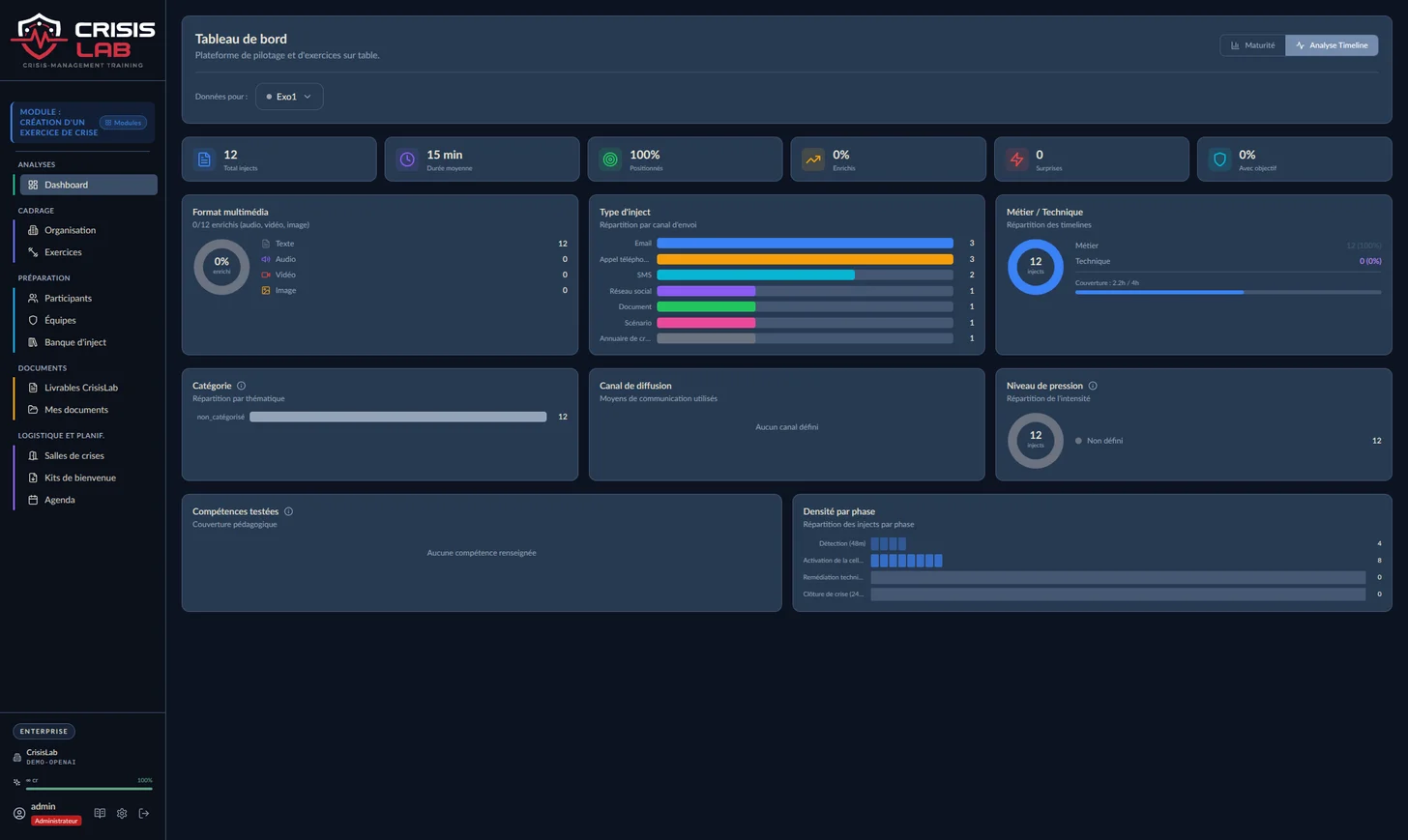
Dashboard — exercise statistics
01 / 06See your exercise's key metrics at a glance: inject formats, delivery channels, pressure points, skills tested and time distribution per phase.
What keeps the practice alive over time
A successful exercise calls for what comes next: run it again, build on it, and account for it.
Simple or Advanced mode
Guided paths in plain language for newcomers, full expert screens for those running the show. Simple mode takes over on mobile by itself.
Creation studio
Your inject bank: categories, ZIP import and export, and sharing granted to other organisations when you decide to.
Shared calendar
Exercises, training sessions and incidents land on a single calendar, shared across every module.
AI credits and quotas
Generative usage is counted in credits, capped per organisation and readable in a usage log.
AI cost under control
FOCUS 1.0 export of AI spend, in the format your FinOps team already reads.
The day it is real — coming
A crisis management module will take over: incident declared, timestamped running log, units mobilised and a cold after-action review. Coming soon.